
Skip to the good bit
ToggleA greasy patch of fluid on the driveway is rarely good news, but some leaks are far more urgent than others. When hydraulic fluid escapes from your suspension, your car is telling you that its ability to grip the road is actively diminishing. While a failing damper might feel like a minor annoyance that you can put off until the next major service, delaying the fix compromises your safety.
Your vehicle relies heavily on functional shock absorbers to maintain tyre contact and stability, meaning an ignored leak will quickly turn a cheap seal failure into a hazardous driving liability.
What Happens Inside a Failing Suspension Unit
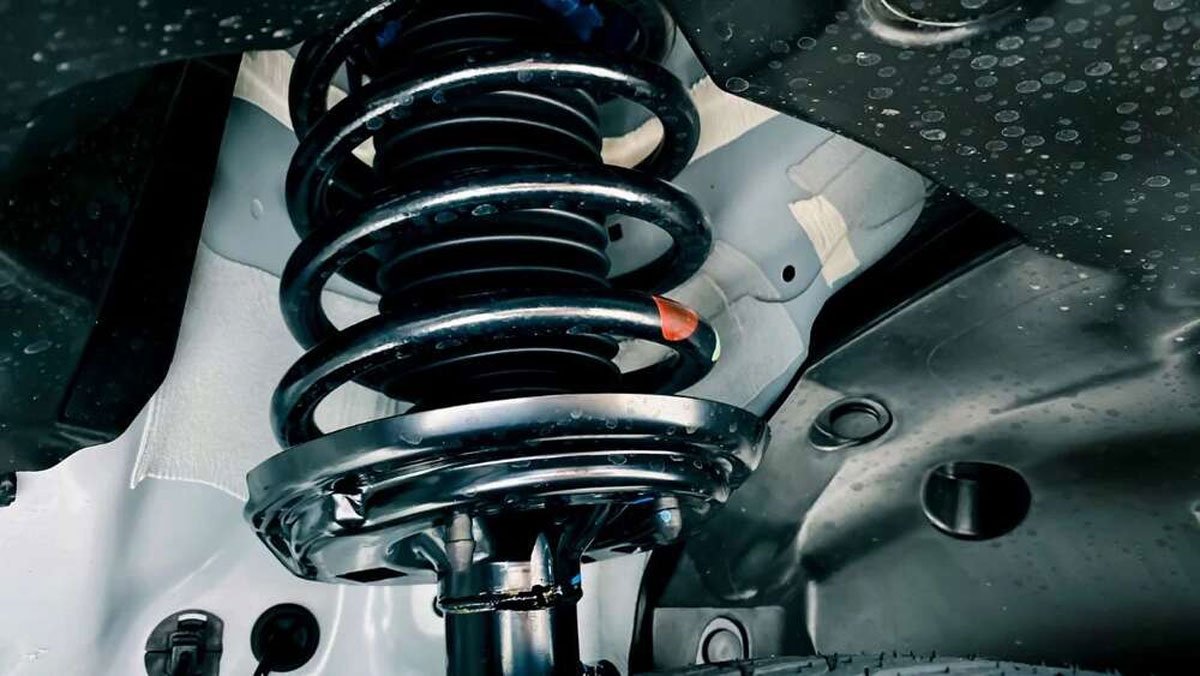
To understand why a fluid leak matters so much, it helps to look at how these components handle the energy of the road. Your suspension springs take the initial impact of a bump, but without a damper to control them, those springs would keep bouncing indefinitely. Inside the metal casing, a piston moves through a chamber filled with specialised oil and pressurised gas, creating the hydraulic resistance required to smooth out the ride.
When a rubber seal degrades and that vital fluid begins to weep out, the system loses its internal pressure. At first, you might only notice a light film of oil collecting dust on the outside of the unit. Eventually, the dampness turns into distinct streaks and drips, leaving the internal valving with nothing to push against. Because this loss of resistance happens over thousands of kilometres, many drivers simply adapt to the increasingly loose handling without realising how degraded their suspension has become.
How Internal Fluid Loss Compromises Road Safety
Driving with an empty or weeping damper changes how your vehicle behaves when you need to make a sudden, evasive decision. Without the correct fluid volume to restrict spring movement, your tyres will actually bounce off the bitumen rather than rolling smoothly over it. If your tyre isn’t making solid contact with the road, you cannot steer or brake effectively. This becomes instantly noticeable when cornering on an uneven surface, where the car will tend to drift or step outward as the suspension struggles to control the body weight.
The danger spikes during heavy braking. When you hit the brakes hard, the weight of the vehicle naturally pitches forward. If the front dampers are compromised, the nose of the car dives excessively, lifting weight off the rear wheels and reducing their grip. Your anti-lock braking system can easily become confused by the lack of tyre contact, which can add multiple metres to your total stopping distance, an incredibly risky variance in emergency traffic scenarios.
The Costly Chain Reaction of Accelerated Wear
Putting off a mechanical repair rarely saves money in the long run, and suspension issues are notorious for destroying perfectly good surrounding parts. When one corner of the car loses its damping ability, the raw impact force of every pothole travels directly into the chassis. Components like rubber bushes, ball joints, control arms, and top mounts are suddenly forced to absorb structural loads they were never designed to handle, leading to premature splitting and expensive secondary failures.
Your tyres will also bear the brunt of an unmanaged bounce. When a wheel is allowed to hop down the road, it creates an irregular wear pattern known as tyre cupping or scalloping. The tread is essentially gouged out in wavy patches across the tyre circumference, creating a loud, rhythmic droning noise at highway speeds. Instead of just replacing a leaking damper, you quickly find yourself paying for a brand-new set of tyres and a wheel alignment.
Identifying the True Warning Signs of Damping Failure
While seeing wet oil on the body of the strut is conclusive evidence of a leak, your car will usually provide plenty of behavioural warnings from the driver’s seat. A metallic knocking or clunking sound when driving over speed humps is a common sign that the unit has lost enough fluid to allow the internal mechanism to bottom out. You might also notice a floating sensation over highway dips, where the vehicle takes three or four full bounces to settle back down.
Steering accuracy tends to wander, requiring constant small corrections just to stay centred in your lane. If the car feels loose during acceleration or pitches forward aggressively the moment you touch the brake pedal, the hydraulic integrity of your suspension system is gone. Catching these symptoms before the unit runs completely dry protects the internal valving from total destruction and keeps your repair options straightforward.
Final Thoughts
Catching a suspension issue early is always preferable to dealing with an unpredictable car during an emergency. A leaking damper is not a cosmetic flaw or a minor leak that can be topped up; it is the physical evidence of a critical safety system losing its ability to protect you from the road. Taking care of the issue promptly keeps your handling predictable, your stopping distances short, and your maintenance budget under control before secondary component damage takes over.
Investing in high-quality replacement units restores that original factory crispness to your steering, ensuring your vehicle handles beautifully and stays firmly planted on the road.