
Hunting season has always required careful preparation. Long before sunrise, hunters may need to move equipment from a truck or campsite to a distant trail, stand, or observation point. The route might include gravel roads, muddy tracks, steep hills, snow, or miles of ground that would take significant time and energy to cover on foot.
Traditionally, the main choices were walking or using a truck, ATV, or other motorized vehicle where permitted. Now, a third option is becoming increasingly practical: the electric hunting bike.
Built around the familiar form of a bicycle but equipped with motor assistance, wider tires, and stronger carrying capacity, these bikes can help riders move through outdoor environments with less effort than walking and less noise than a gas-powered vehicle. They are not replacements for planning, field skills, or responsible access. Instead, they give hunters and outdoor adventurers another way to reach camp, transport equipment, and explore more ground during a day outside.
Why an eBike Makes Sense During Hunting Season
The appeal of an electric hunting bike starts with the gap it fills. Walking is simple and quiet, but distance, hills, and heavy equipment can consume energy before the main part of the day begins. Trucks and ATVs can carry more, but they are louder, require fuel, and are not permitted on every route.
Electric bikes sit somewhere between those two options. Pedal assistance reduces the effort needed to climb or travel with a load, while the compact size of a bicycle makes parking, storage, and transportation more manageable than a larger vehicle. Electric motors are also much quieter than gas engines, although no bike or rider is completely silent.
That versatility can be useful throughout the season. An eBike may support preseason route checks, trips between a campground and trailhead, gear transportation, or general exploration on approved roads and trails. Outside hunting season, the same bike can be used for camping, fishing, photography, and other outdoor adventures, giving it more year-round value than a highly specialized vehicle.
What Makes an Electric Hunting Bike Different?
Not every eBike is designed for rugged outdoor use. A lightweight city model may be excellent for pavement, but hunting routes often require more traction, stronger brakes, useful suspension, and enough capacity for equipment. The following features matter more than an aggressive appearance.
Tires Designed for Mixed Terrain
A fat tire eBike commonly uses tires around four inches wide. The larger contact patch and extra air volume can improve stability and comfort on gravel, packed dirt, loose soil, sand, and snow. Wider tires can also help a rider feel more confident when the surface changes unexpectedly.
Fat tires have tradeoffs. They add weight and rolling resistance, and they do not turn a bike into a motorcycle or a purpose-built mountain bike. Their advantage is versatility across the mixed surfaces commonly found around camps, forest roads, and rural properties.
Motor Support for Hills and Loaded Rides
Motor wattage attracts attention, but torque and power delivery can be just as important. A useful electric hunting bike should provide controlled assistance when starting with equipment or climbing on loose ground. Abrupt power can make traction harder to manage, while smooth assistance helps the rider maintain a steadier line.
Gearing still matters. Riders should shift into a suitable gear before a climb rather than expecting the motor to do all the work. Good technique can improve control, reduce strain on the drivetrain, and help conserve battery.
Range That Matches the Real Route
Range claims should always be viewed as estimates rather than guarantees. Hills, cold weather, soft terrain, rider weight, cargo, tire pressure, speed, and high assistance levels can reduce how far electric bikes travel on one charge.
For hunting season, the route home matters as much as the route out. Riders should calculate the complete distance, account for elevation, and keep a battery reserve for detours or changing conditions. Remote trips should never depend entirely on achieving the maximum advertised range.
Suspension and Brakes for Better Control
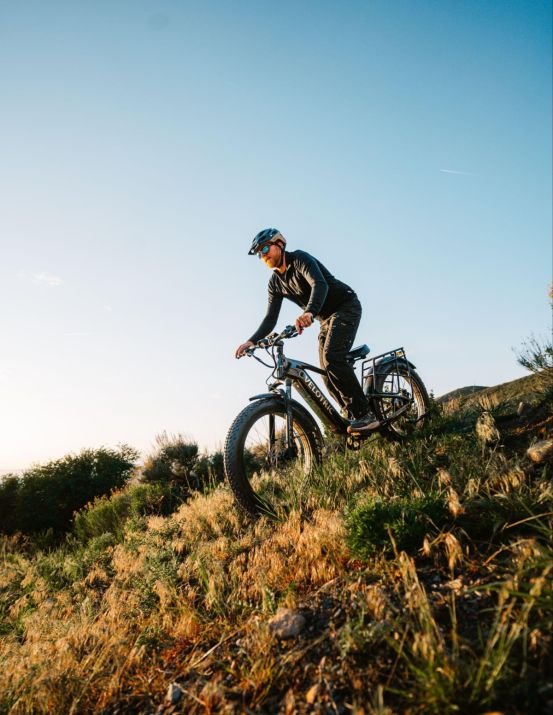
Suspension can reduce repeated impacts on rough roads and help the tires remain in contact with uneven ground. A suspension fork may be enough for maintained gravel, while full suspension can add comfort and control when the route includes repeated bumps and ruts.
Brakes become especially important on a heavier bike carrying equipment. Hydraulic disc brakes generally offer consistent stopping with less hand effort, but riders should still brake earlier and leave more room when the bike is loaded.
Practical Carrying Capacity
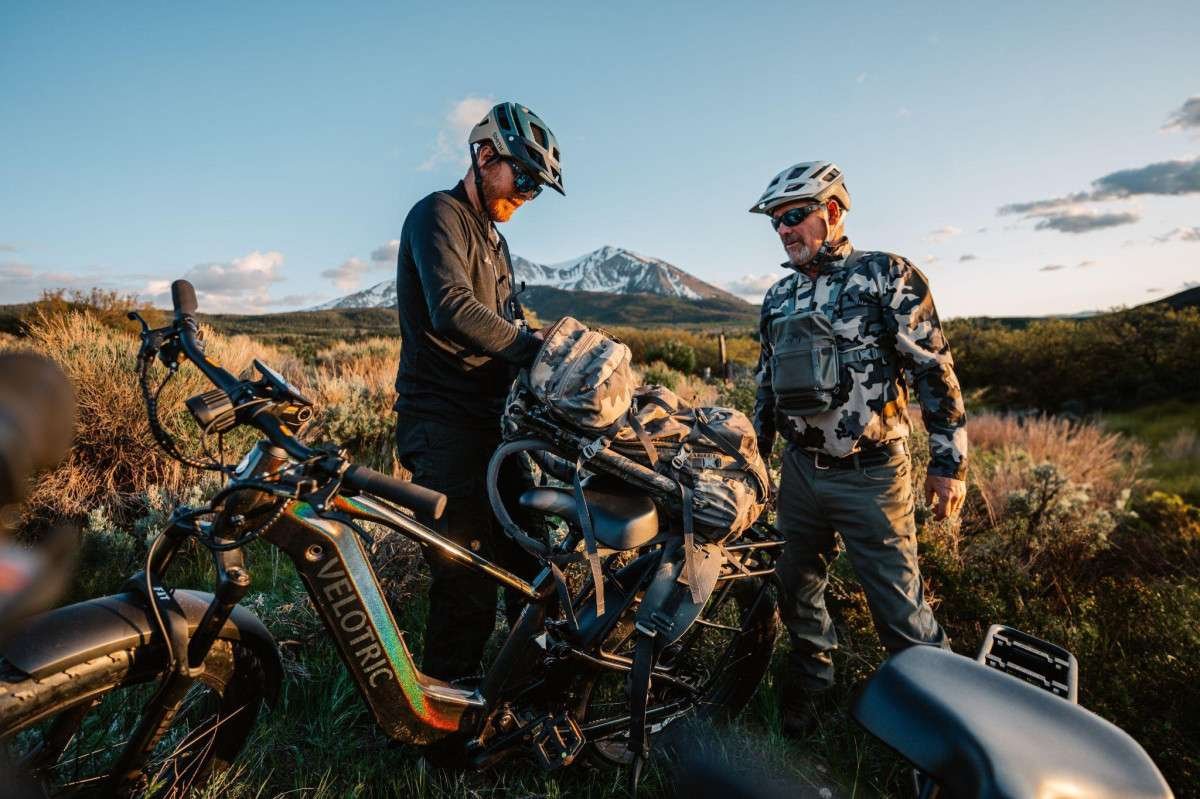
A rear rack, panniers, or a compatible trailer can keep equipment off the rider’s back. Before loading, check both the bike’s total payload rating and the separate limit of the rack or accessory. Total payload usually includes the rider and everything carried on or behind the bike.
Keeping heavier items low and evenly distributed can improve balance. Loose straps should always be secured away from the wheels, brakes, chain, and drivetrain.
Where the Velotric Nomad 2X Fits
The Velotric Nomad 2X is a full-suspension fat tire eBike designed for riders who want outdoor capability without moving into electric motorcycle territory. Its features align closely with the practical demands of hunting, camping, and backcountry exploration.
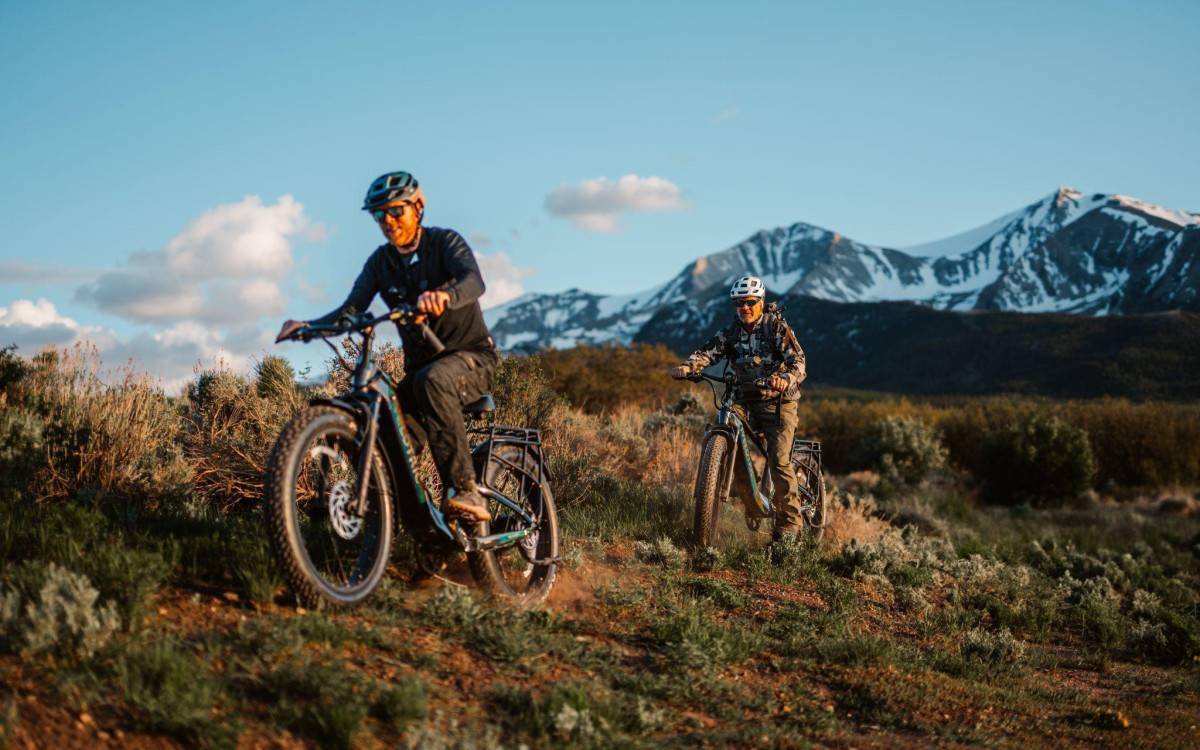
The 750W motor delivers up to 1,400W of peak power and 105 Nm of torque, providing extra support on hills and loaded rides. Four-inch tires help the bike stay composed on gravel, forest roads, sand, and snow, while a 120 mm adjustable front air fork and 80 mm of rear wheel travel absorb repeated bumps at both ends of the bike.
For longer routes, the Nomad 2X offers up to 75 miles of pedal-assist range. Actual range depends on conditions and load, but the large battery gives riders more room to plan outdoor trips with a sensible reserve.
Carrying capacity is another reason it works as an electric hunting bike. The bike supports up to 560 lbs of total payload, and its integrated rear rack is rated for up to 120 lbs. That capacity can accommodate outdoor equipment, panniers, and other compatible carrying setups without forcing everything onto the rider’s back.
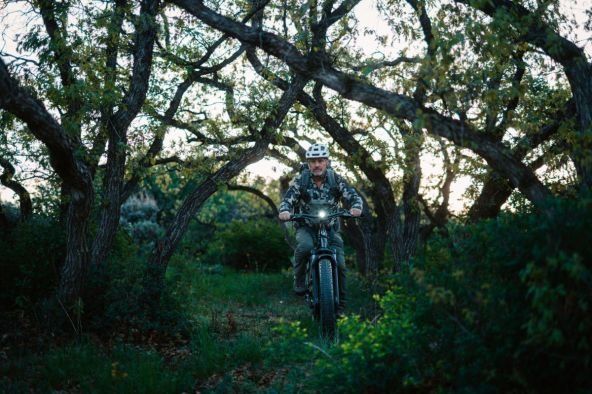
Nomad 2X also includes a Stealth Mode designed for lower-profile riding. It turns off the lights, dims the display, and limits speed for quieter, more controlled movement. Riders should use this feature only when conditions allow safe operation and should never ride without required lighting on public roads or in low-visibility situations.
At approximately 80 lbs, the Nomad 2X is a substantial bike. Buyers should consider how they will load it into a vehicle, store it, and transport it to the starting point. That weight is part of the tradeoff for full suspension, fat tires, a large battery, and heavy-duty capacity.
A Hunting eBike Is Also an Adventure Bike
One reason the category is growing is that these bikes are useful beyond a few weeks of hunting season. A capable fat tire eBike can support camping trips, fishing runs, forest-road exploration, and weekends spent discovering new outdoor routes.
This broader use changes the buying decision. Instead of purchasing a tool that serves only one purpose, riders can choose an electric bike that carries equipment during hunting season and remains enjoyable during the rest of the year. A rack can hold panniers for camp supplies one weekend and food or photography equipment the next.
The same versatility also makes fit and comfort important. A bike that can haul a large load is not automatically pleasant to ride for several hours. Saddle position, handlebar reach, suspension setup, bike weight, and frame access should all be considered before purchase.
A New Tool for a More Flexible Outdoor Season
The rise of electric hunting bikes reflects a broader change in outdoor transportation. Riders want a tool that can help with distance and equipment without requiring a truck or ATV for every trip. They also want something useful after hunting season ends.
The right fat tire ebike can meet both needs. It can support early starts, hilly routes, equipment runs, and long days outdoors, then return for camping, fishing, or simple weekend exploration later in the year.
For riders comparing outdoor-focused electric bikes, the best choice is not simply the model with the largest motor or most rugged appearance. It is the bike whose range, tires, brakes, suspension, carrying capacity, weight, and access classification match the places they genuinely plan to ride. The Nomad 2X offers one example of how those features can come together in a versatile tool built for hunting season and the adventures beyond it.