
Skip to the good bit
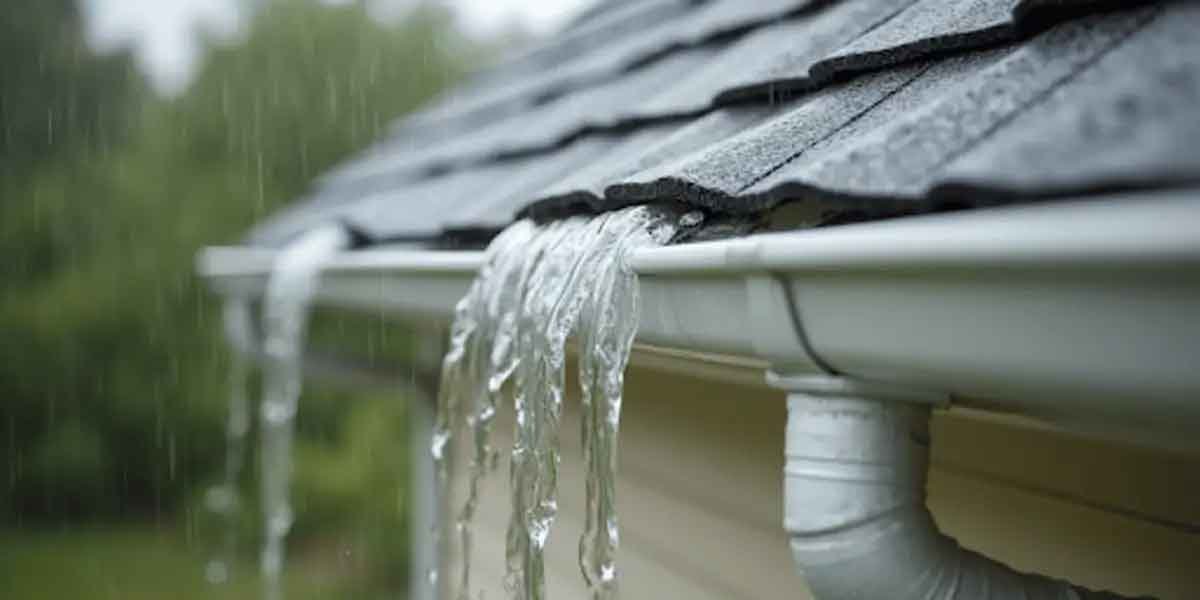
ToggleMost homeowners see overflowing gutters as a nuisance, water spilling over the edge during a rainstorm, maybe some splashing near the front door. It’s easy to chalk it up to a heavy downpour and move on. But overflowing gutters are rarely just a weather problem. They’re a symptom, and what they’re pointing to matters far more than the overflow itself.
Clogs
The most common cause of overflowing gutters is a blockage. Leaves, twigs, shingle grit, seed pods, and other debris accumulate in the trough over time and restrict water flow toward the downspout. When water can’t move freely, it has nowhere to go but over the edge.
A clog tells you something specific: your gutters haven’t been cleaned recently enough for your home’s environment. Homes surrounded by mature trees may need cleaning two to three times per year rather than the standard once annually. If overflows happen regularly despite recent cleaning, the debris load your gutters face has outpaced your current maintenance schedule.
When Clogs Aren’t the Problem
If your gutters are clear but still overflowing, the issue runs deeper.
The Gutters Are Improperly Sloped
Gutters must be installed at a precise pitch to move water efficiently toward the downspout. Over time, hangers loosen, gutters sag, and that slope is lost. Sections of gutter that have gone flat or begun pitching the wrong direction will pool water and overflow even when completely free of debris. This is a structural issue with the installation itself, not a maintenance failure on the homeowner’s part.
The Gutters Are the Wrong Size
Standard 5-inch gutters handle the runoff from most residential rooflines adequately. But homes with steep roof pitches, large roof surface areas, or complex architectural features generate significantly more runoff volume per square foot than a standard calculation assumes. If your gutters overflow consistently during moderate rainfall, they may simply be undersized for your home. Upgrading to 6-inch gutters, or adding additional downspouts to reduce the load on each section, is the correct solution.
The Downspouts Can’t Keep Up
Even properly sized and sloped gutters will overflow if the downspouts are too few, too small, or themselves blocked. Downspouts are the exit point for everything the gutters collect. A single clogged or undersized downspout can back up an entire run of gutter and cause overflow across a wide section of the roofline.
What the Overflow Is Doing to Your Home
Wherever overflow lands consistently, damage follows. Against the fascia board, it accelerates wood rot. Along the siding, it creates moisture intrusion pathways that lead to mold, warping, and paint failure. At the foundation, it begins the slow process of soil saturation that can eventually translate into hydrostatic pressure, cracking, and costly structural remediation.
The Right Response Is a Diagnosis, Not a Delay
Overflowing gutters are your home communicating that something in the water management system isn’t working. The answer might be a cleaning, a rehang, a downspout addition, or a full upgrade to a larger gutter profile. Identifying which fix applies requires an experienced eye.