**This post is sponsored by Semrush. When you purchase through links in this article, we may earn an affiliate commission from Semrush.**
The next era of search is no longer driven by keywords alone. To understand how your brand appears across AI-powered search engines and generative models, explore the capabilities of Semrush One.
The search landscape is undergoing a major transformation as AI-powered systems take center stage. Instead of relying solely on traditional keyword patterns, systems like ChatGPT, Perplexity, and Gemini build their understanding of brands through semantic associations, entity relationships, and distributed digital conversations. This shift has given rise to a new discipline: semantic signal engineering.
Semantic signal engineering focuses on shaping how AI interprets your brand across both structured and unstructured online environments. Rather than optimizing for singular keywords, marketers are now building semantic patterns that help AI systems connect a brand to its core category. As search engines evolve into generative engines, this approach becomes central to visibility, trust, and relevance.
Why Semantic Signal Engineering Matters
Search Engines and AI Models Learn from Conversations, Not Just Websites
Modern AI systems compile brand narratives from Reddit, Discord, Slack channels, review platforms, social media discussions, and communities spread across the web. These conversations collectively influence how LLMs describe and rank brands, often more than the brand’s own website.
For marketers and CMOs, this creates a visibility gap. The story you intend to tell is not always the story AI systems present.
Market Challenges Driving the Shift
1. Strategic Misalignment Across SEO Teams
Many SEO practitioners still rely heavily on classic keyword optimization. But generative search engines focus on entity salience, contextual relationships, and topic-level authority. This misunderstanding leads to misaligned strategies, declining organic performance, and inefficiencies in content creation.
2. Loss of Brand Narrative Control
With AI pulling data from distributed online sources, brands often lose control of their identity. AI-generated answers may not match the brand’s real positioning. This lack of narrative control impacts customer perception, competitive positioning, and overall brand trust.
3. Technical Barriers in Entity Recognition
Missing or incomplete Organization and WebSite schema prevent search engines from properly identifying a brand. Without clear entity definition, brands struggle to appear in autocomplete, knowledge panels, product listings, and AI-generated responses.
AI Visibility Toolkit: The Core Solution
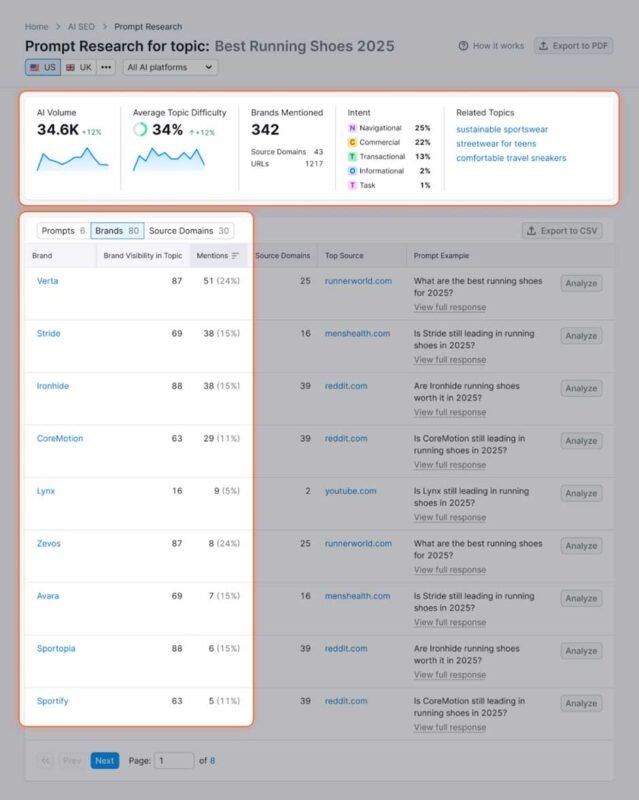 The AI Visibility Toolkit, part of Semrush One, directly addresses these challenges by turning semantic signal engineering into a measurable, repeatable process.
Key Capabilities Include:
- Measuring AI market share across ChatGPT, Perplexity, and Gemini
- Mapping topic associations connected to your brand
- Analyzing sentiment and tone of AI-generated mentions
- Identifying user questions related to your brand
- Benchmarking your AI visibility against competitors
This toolkit brings transparency to an otherwise hidden world: what AI systems actually say about your brand.
Turning GEO Into Actionable Metrics
Generative Engine Optimization (GEO) has been difficult for brands to operationalize—until now. The AI Visibility Toolkit helps transform it into real, trackable KPIs:
- AI Visibility Share
- Sentiment Trends
- Entity Relationships and Topic Associations
- Category-Level Share of Voice in LLMs
This shift allows marketers to influence AI perception through measurable strategies rather than guesswork.
Semrush One Toolkit for Stronger Semantic Visibility
For the most comprehensive approach, Semrush One integrates the full power of both the AI Visibility Toolkit and the SEO Toolkit—delivering end-to-end visibility across traditional search and generative AI systems. The unified platform enables teams to move seamlessly from insight to execution with:
- Keyword intelligence
- Competitive analytics
- AI perception tracking
- Entity optimization
- Content and technical SEO workflows
Semrush One serves as a single source of truth for navigating the GEO era and offers the best value by combining both toolkits into one powerful solution.
Strategic Framework: Semantic Signal Engineering
Semantic signal engineering elevates entity optimization into a larger discipline focused on:
- Building strong brand-category associations
- Influencing AI model understanding
- Creating deep topical authority
- Deploying schema for faster entity recognition
- Prioritizing commercial intent over traffic volume
In today’s landscape, the brands that succeed are those who align content, schema, and distributed digital signals to shape AI interpretation.
Key Strategic Angles
1. Paradigm Shift
Keyword-centric SEO alone is obsolete. AI-driven inclusion depends on passage-level relevance, topical authority, and entity clarity.
2. Schema Speed
Entity recognition can happen in a single week when Organization and WebSite schema are properly deployed.
3. Commercial Intent ROI
Brands that focus on commercial intent, even with lower traffic volume, see higher revenue and stronger generative search visibility.
Final Call to Action
 Take control of your AI-driven search presence by understanding exactly how generative engines interpret your brand. Start tracking your semantic authority, visibility score, and entity recognition today with Semrush One.