
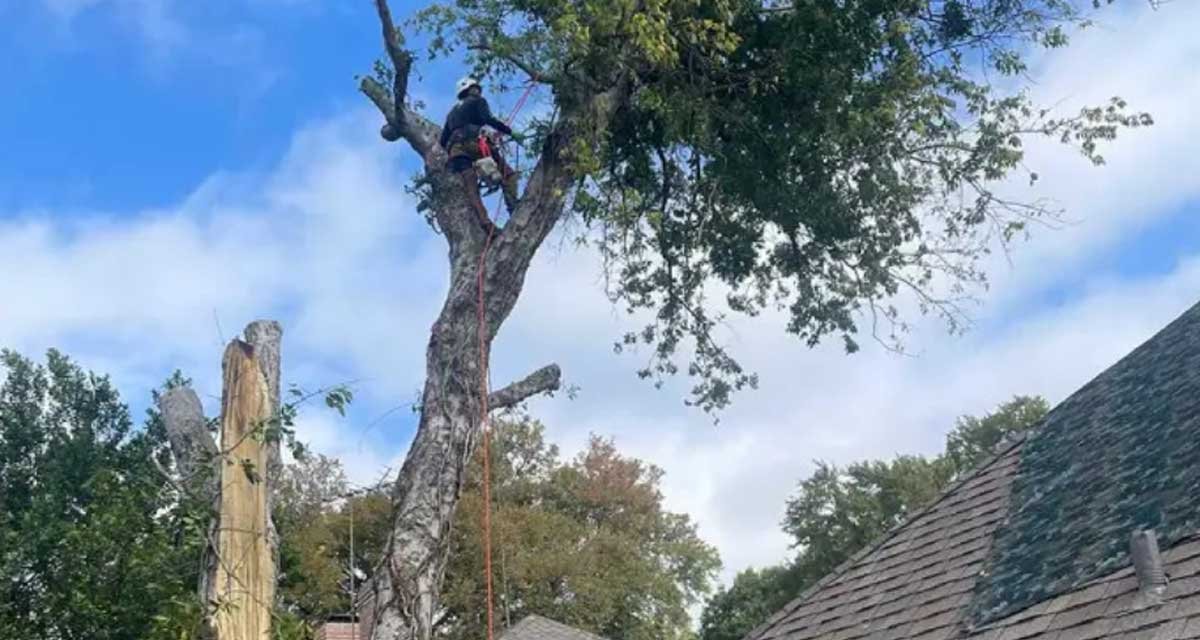
Skip to the good bit
ToggleWhen severe weather approaches, most Fort Worth homeowners think about protecting their homes, vehicles, and outdoor spaces. But there’s something often overlooked that can cause significant damage during a storm: hazardous trees.
A tree that looks healthy on the outside may hide internal weaknesses capable of turning it into a serious threat once heavy winds arrive. At Fort Worth Arborist Co., we help property owners identify and resolve these hidden dangers long before the first thundercloud forms.
Catching problems early can prevent expensive damage and maintain the curb appeal and safety of your landscape.
Here are five key warning signs that your tree may be at risk of falling during a storm.
1. Leaning or Unstable Growth
A leaning tree isn’t always an immediate hazard. Some species naturally grow at an angle, and some trees adapt to uneven sunlight by tilting over time. However, a sudden lean or noticeable shift in position is a serious red flag. It often signals root instability or internal decay near the base of the trunk.
If you notice a tree leaning more after heavy rain or wind, it could mean the root system has weakened, no longer securing the tree effectively in the soil. Trees that move or sway at their base during strong gusts are particularly dangerous.
A certified arborist can determine whether the lean is natural or structural. If the soil around the base appears cracked or raised, or if the tree seems to be pulling away from the ground, immediate attention is needed. Taking action early can prevent collapse during the next storm.
2. Cracks or Splits in the Trunk and Major Limbs
The trunk is the tree’s support system, and visible cracks or splits along this area can signal internal damage. These openings often occur after stress from high winds, improper pruning, or storm impact.
A vertical crack in the trunk or a long split in a large branch weakens the structural integrity of the tree. Once weakened, the tree may not withstand the weight of future storms. These cracks allow moisture to enter, inviting decay fungi and boring insects that accelerate internal rot.
Inspect the main trunk for deep fissures, separated bark, or visible cavities. If you can see through a split or hear hollow sounds when tapping the trunk, the internal wood may be compromised. A professional arborist can use diagnostic tools to assess the depth of the damage and recommend whether pruning, cabling, or removal is the safest option.
3. Dead or Falling Branches
When a tree begins dropping large branches without reason, it’s a sign of stress, decay, or disease. Live, healthy trees do not shed limbs frequently. Deadwood, on the other hand, becomes brittle, cracks easily, and can break off under its own weight or with minimal wind.
Storms often exploit these weaknesses.
A single falling branch can damage your property, vehicles, or power lines. In some cases, detached limbs can also injure anyone nearby. So, walk around your property and look for branches with no leaves, peeling bark, or sections that appear gray and dry while the rest of the canopy remains green.
These are signs of dieback, which is a condition where sections of the tree lose nutrients and eventually die off completely. Proper tree trimming and pruning by a certified arborist helps remove hazardous limbs safely and stimulates new, healthy growth.
4. Fungal Growth or Decay at the Base
One of the clearest signs of internal weakness is fungal growth at the base of the trunk or near large roots. Mushrooms, conks, or soft spots on the bark often indicate root rot or internal decay. These fungi feed on decaying wood, meaning the internal fibers of the tree are already breaking down.
Rot typically starts where water collects, around the root flare or near the base of the trunk. Over time, this reduces the tree’s ability to transport nutrients and maintain structural stability. Trees affected by root decay may appear healthy in the canopy for years before suddenly failing.
To check for decay, look closely at the lower trunk and soil line. Press gently on any soft spots or darkened areas. If the wood gives easily under pressure or you notice excess moisture, the tree could be unstable.
An expert tree risk assessment can determine if the tree can be saved through pruning or bracing. If decay has reached a critical point, tree removal may be the only safe solution to prevent property damage during high winds.
5. Root Damage or Soil Disturbance
The root system provides the foundation for every tree. Even when the canopy looks healthy, hidden root damage can make a tree prone to sudden collapse. Construction work, heavy foot traffic, grading, or trenching for utilities often cut or compact roots, leading to long-term instability.
Look for warning signs around the base:
Uplifted soil on one side of the trunk
Exposed or severed roots
Sparse leaves or a thinning canopy
Fungal growth along roots
If you recently had driveway or foundation work completed, those changes could have disrupted your trees’ stability. Damaged roots cannot anchor the tree or absorb nutrients efficiently, increasing the risk of toppling during storms.
What to Do if You Suspect a Hazardous Tree
If you notice any of these five signs: leaning, cracking, deadwood, fungal growth, or root damage, do not wait for severe weather to confirm your concerns. The safest step is to call a certified arborist for a full assessment. Expert evaluation identifies structural weaknesses and provides clear guidance on next steps.
Here’s what to expect:
- A visual assessment of the trunk, canopy, and roots
- Diagnostic testing for decay or disease
- Recommendations for trimming, support systems, or removal
- A long-term care plan to promote safe growth
Keep Your Property Safe Before the Storm
No homeowner wants to deal with a fallen tree after a storm. Today’s preparations can save you time, money, and stress tomorrow. By identifying hazards early, you take control of your property’s safety and protect your investment.
Fort Worth Arborist Co. helps residents across Fort Worth, TX, make confident decisions about their trees. We offer tree inspections, pruning, disease treatment, and emergency tree removal when needed.
Call us at 817-975-0180 or book an appointment online now.
FAQs about Tree Hazards
- How can I tell if my tree is at risk of falling during a storm?
- Look for visible signs of weakness such as leaning trunks, cracks, dead branches, fungal growth, or soft spots at the base. These signs often mean the tree’s structural integrity is compromised. If you notice any of these, schedule a tree inspection with a certified arborist right away.
- What should I do if I find fungus or mushrooms growing around my tree?
- Fungal growth often points to internal decay or root rot. While some surface fungi are harmless, most indicate that the tree is weakening inside. An arborist can examine the extent of the decay and determine whether tree removal or targeted treatment is the safest option.
- Is a leaning tree always dangerous?
- Not always. Some trees grow with natural leans, especially if they reach for sunlight. However, a sudden lean, a shift after a storm, or visible soil cracking around the roots means the tree may be unstable. These cases need professional evaluation to prevent potential collapse.
- How often should I have my trees inspected?
- We recommend a professional tree inspection at least once a year, ideally before storm season. Mature or large trees may need more frequent evaluations, especially after severe weather or nearby construction that may affect the root system.
- Can Fort Worth Arborist Co. remove a dangerous tree before a storm arrives?
- Yes, our team provides emergency tree removal, tree cabling and bracing, and stump removal throughout Fort Worth, TX. If a tree poses an immediate threat to your home, we can schedule urgent service to remove or stabilize it before strong winds hit.