
A lot of AI video platforms are easy to admire and harder to judge. Their homepages promise cinematic results, faster production, and creative freedom, but the real question is simpler: does the platform reduce friction when actual work begins? In my testing, SeeVideo AI is most interesting as a review case because it is not trying to be only one model wrapped in a marketing page. It is trying to become a usable workspace where strong video and image models can be selected, compared, and applied with less operational mess.
That distinction matters because creative work rarely fails at the idea stage. It usually fails in the transition from idea to decision. A team may already have a product image, a campaign concept, a scene description, or a piece of music that defines tone. The problem is not imagination. The problem is turning those inputs into outputs that can be evaluated quickly without switching across too many tools, subscriptions, and interfaces. A platform becomes credible when it shortens that distance in a way that feels practical rather than theatrical.
What stood out to me is that SeeVideo AI does not present itself as a single-purpose generator. Its public positioning is broader. It centers Seedance 2.0 for video creation, while also offering access to models such as Veo 3, Sora 2, Seedream, and Nano Banana. That changes how the product should be judged. It is not only a model experience. It is a model selection layer. In professional use, that difference can matter more than one spectacular demo result.
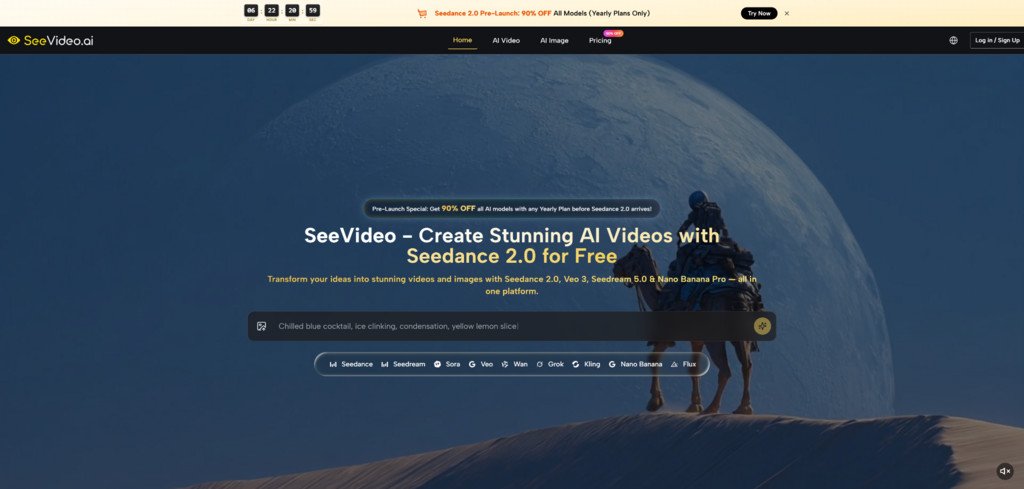
SeeVideo AI Is Best Understood As A Workspace
The most useful way to review the platform is not to ask whether one output looks impressive. Many AI tools can produce one striking clip. A better question is whether the environment around generation helps users make stronger decisions with less wasted effort.
SeeVideo AI appears designed around that logic. Instead of forcing the user into one fixed engine, it gives the platform a clear center with Seedance 2.0 while also showing that different models serve different goals. In my observation, that is one of its more professional qualities. It treats AI creation as a process of choosing, not just prompting.
Why A Unified Model Workspace Matters
This may sound less exciting than output quality, but it has real importance. If a creator needs multi-scene generation, one model may be the right fit. If the goal is stronger photorealism or native audio behavior, another model may be more useful. If the user wants cinematic narrative styling, a different engine may be worth trying.
Without a unified platform, this process can become expensive and inefficient. The user has to maintain separate tools, separate billing habits, and separate mental models of how each system works. A shared workspace lowers that friction. That makes experimentation more reasonable.
The Platform Encourages Comparison Rather Than Blind Trust
One thing I appreciated is that the platform openly supports cross-model comparison as part of the experience. That is healthier than pretending one model should dominate every use case. In creative work, the best result is often not the first result. It is the most suitable result after alternatives have been compared.
That approach also improves learning. Over time, users begin to understand which models are more useful for product demos, which are better for stylized storytelling, and which are better for quick drafts. Seedance 2.0 AI Video becomes more than a generator. It becomes a place where creative judgment can develop.
This Is A Stronger Review Frame Than Hype
A platform like this is easier to respect when judged through workflow value. It does not need to claim perfection. It only needs to make the path from concept to choice more efficient and more understandable.
Professional Tools Usually Improve Decisions First
In real production, better decision-making often matters more than isolated technical brilliance. A system that helps users choose well can be more valuable than a tool that only produces occasional surprise.
Seedance 2.0 Gives The Platform A Clear Center
Even though this is a review of SeeVideo AI as a platform, it still makes sense that Seedance 2.0 sits at the core of the experience. The product pages frame it as the main video engine, especially for multi-scene generation, fast turnaround, and support for text, image, and audio driven workflows.
That central role helps the platform avoid feeling scattered. There is a recognizable main engine rather than a random pile of models. For users, that is important because it creates a natural default starting point.
Multi Scene Generation Raises Its Practical Value
A lot of AI video tools still feel strongest in isolated moments. One shot may look attractive, but the system becomes less convincing once it has to handle sequence, pacing, or transitions across several scenes. SeeVideo AI seems aware of that problem, and it uses Seedance 2.0 to address it.
In my testing, that matters because many professional tasks require more than one visual idea. Even short clips need some progression. Product storytelling, ad concepts, and social content often benefit from scene development rather than a single animated moment.
Text Image And Audio Inputs Improve Control
Another professional strength is input flexibility. The platform presents Seedance 2.0 as capable of working from text, images, and audio. That is meaningful because real projects do not always begin from the same kind of material.
Some users start with a written scene. Others already have a visual reference. Some have audio or rhythm that shapes how motion should feel. A model becomes more useful when it accepts these different forms of intent without forcing everything into one prompt-only workflow.
Fast Turnaround Supports Real Iteration
The official pages also frame generation speed as part of the value. That matters because creative iteration only feels practical when each attempt does not carry too much time cost. In my observation, this is one reason the platform feels more usable than many more abstract AI demos. It is not just trying to impress. It is trying to keep the generation loop short enough to support normal working habits.
Speed Matters More When Comparison Is Built In
Fast generation becomes much more valuable when the platform also encourages side-by-side evaluation. It means users can move from idea to options without turning each test into a separate production event.
The Broader Model Mix Makes The Platform More Useful
A review of SeeVideo AI would be incomplete if it focused only on Seedance 2.0. Part of the platform’s appeal is that it includes other major models with different strengths. That broadens the creative range.
Different Models Serve Different Creative Jobs
From the platform’s public descriptions, Veo 3 is positioned more toward photorealistic output and native audio, while Sora 2 is described in more cinematic and narrative terms. Seedream and Nano Banana expand the image side of the workflow. That matters because many projects move between image generation and video generation rather than staying inside only one medium.
A creator might generate a concept image first, then move into animation. A marketing team might need both product visuals and short video assets in the same campaign cycle. The mixed model environment makes that transition easier to imagine.
The Platform Is Stronger Because It Is Not One Note
One weakness of many AI products is that they become repetitive after the first impression. A platform with multiple strong models has a better chance of staying useful because it supports several kinds of work. That makes SeeVideo AI feel broader and more durable than a single-engine landing page.

The Shared Asset Logic Has Quiet Value
Even though this is not the flashiest part of the pitch, the promise of a single place for creation, comparison, and asset handling is important. Fragmented workflows waste energy. A unified environment creates less administrative drag, and that is often what determines whether a tool becomes part of regular work.
Breadth Helps Only When The Interface Stays Clear
To the platform’s credit, the broader model offering still seems organized around understandable choices. That makes the breadth feel usable rather than chaotic.
The Official Workflow Stays Short And Understandable
One of the better design choices here is that the visible process remains simple. The platform does not require a complicated setup before any result appears.
Step One Choose The Starting Mode
Users begin by deciding whether the project starts from text or image. This is a sensible first step because it reflects how ideas actually arrive.
Step Two Select The Model That Fits The Goal
The user then chooses the model that best matches the desired output. Seedance 2.0 acts as the central default, but the platform also makes room for other engines when realism, cinematic style, or image generation become more important.
Step Three Generate Compare And Keep The Best Version
After that, the practical workflow becomes generation followed by comparison. In my view, this is one of the strongest parts of the product logic. It treats AI creation as a selection process rather than a one-click miracle.
A More Useful Review Table For Real Work
| Review Area | What SeeVideo AI Offers | Why It Matters |
| Platform structure | Multiple premium models in one workspace | Reduces switching across tools and subscriptions |
| Core video engine | Seedance 2.0 as the central default | Gives the product a clear starting point |
| Input flexibility | Text, image, and audio guided creation | Matches how real projects often begin |
| Comparison workflow | Cross-model evaluation is built into the experience | Helps users choose better outputs |
| Creative range | Video and image models are both available | Supports broader campaign and content workflows |
| Generation speed | Positioned for relatively fast turnaround | Makes iteration more realistic |
| Rights and usability | Framed for commercial use | Makes the platform easier to place in professional work |
Where SeeVideo AI Feels Most Convincing
The platform feels strongest in situations where a team or creator needs options quickly rather than perfect output immediately.
Marketing And Product Content
Teams with existing visuals can use the platform to test motion, build short promo ideas, and explore variants without organizing a full shoot or edit process every time.
Creative Prototyping
For concept testing, mood exploration, and short narrative drafts, the platform’s model variety has clear value. It lets users test not only one result, but several creative directions.
Small Teams With Limited Production Capacity
Smaller teams often have good ideas and weak bandwidth. A platform that compresses generation, comparison, and selection into one place can solve that problem meaningfully.
The Limitations Are Still Important
A balanced review should also be honest about where the platform still depends on user skill and patience.
More Models Also Mean More Decisions
Choice is useful, but it can also create a mild learning curve. Users still need to understand which model fits which task.
Prompt And Reference Quality Still Matter
A unified platform does not remove the need for clear direction. Better prompts and better visual references still tend to produce stronger results.
Iteration Is Part Of The Process
In my testing, the best output does not always arrive on the first attempt. The platform makes iteration easier, but it does not eliminate the need for it.
This Is A Strength If Expectations Stay Realistic
The product becomes more convincing when treated as a system for faster decision-making rather than a promise of instant perfection.
SeeVideo AI Feels Strongest As A Practical Creative Hub
My overall view is that SeeVideo AI is more persuasive as a platform than as a simple model showcase. Its value comes from combining a central engine, a broader model roster, and a workflow that encourages comparison instead of blind trust. That makes the experience feel more useful for real work.
In my observation, the platform’s biggest strength is not one dramatic feature. It is the way several practical ideas work together: a clear default model, multiple strong alternatives, flexible starting inputs, fast generation loops, and an environment built for evaluation. For people who care less about hype and more about whether a tool can support repeatable creative decisions, SeeVideo AI is easier to take seriously than many louder products in the same space.