Skip to the good bit
ToggleConcrete work looks straightforward—until it isn’t. That’s the moment most homeowners wish they’d made a different call before the project started.
Every year, thousands of people tackle concrete projects with confidence, armed with rental equipment and YouTube tutorials. Some pull it off. Many don’t. The difference usually comes down to one thing: understanding what concrete work actually demands—not just in materials, but in skill, time, and long-term results.
This post breaks down the real costs on both sides of the decision so you can walk into your next project with a clear head and realistic expectations.
The DIY Appeal: Where It Comes From
The savings pitch is hard to ignore. Skip the labor costs, rent the tools, buy the mix, and handle it yourself. On paper, a DIY concrete driveway or patio can appear to cost a fraction of a professional job.
That math, however, rarely holds up once the work begins.
Mixing ratios matter more than most people expect. Too much water weakens the slab. Poor compaction creates voids underneath. Incorrect grading leads to pooling water. These aren’t corner cases—they’re some of the most common issues that show up months after a DIY pour, long after the project feels “done.”
There’s also the physical reality. Concrete is heavy, time-sensitive, and unforgiving. Once it starts to set, your window to correct mistakes closes fast. Without experience, that pressure alone can derail an otherwise careful effort.
What Professionals Actually Bring to the Job
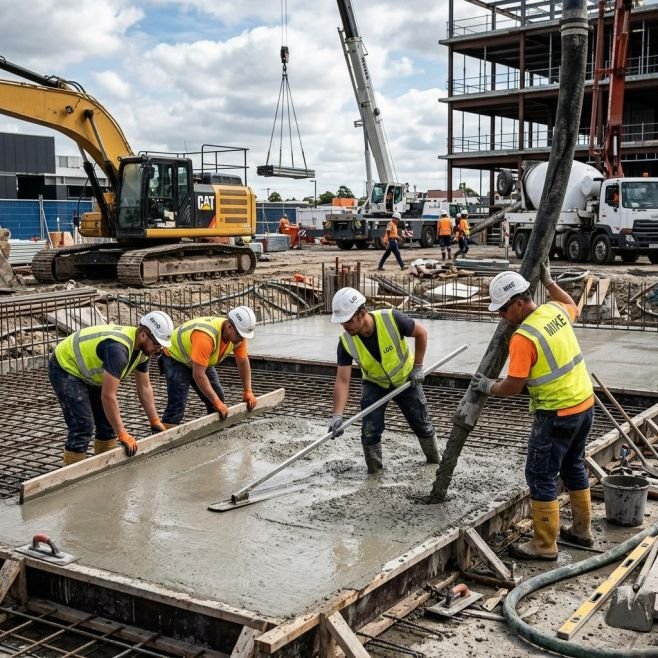
A skilled Concrete contractor brings far more than just labor—they bring years of site-specific expertise that protects your investment, ensures code compliance, and delivers a finished product that holds up through freeze-thaw cycles, heavy loads, and the test of time.
That line captures more than most people realize before they’ve priced out a project properly.
Here’s what professional concrete work actually includes:
Site preparation: Grading, base compaction, and proper drainage planning. This is the foundation beneath the foundation. Skip it, and cracking or sinking is almost inevitable.
Mix design: Professionals match the concrete mix to the application—whether it’s a decorative patio, a structural driveway, or a garage floor. The wrong mix, even when poured correctly, will fail under the wrong conditions.
Formwork: Setting forms correctly ensures clean edges, consistent thickness, and proper slope for drainage. It also affects how well the finished surface looks years down the line.
Curing: This is where most DIY projects fall short. Concrete needs to cure at the right rate to achieve its rated strength. Rushing this process—or skipping sealing steps—leads to surface deterioration much sooner than it should.
Permits and compliance: Depending on your local codes, certain concrete installations require permits. Missing this step can create problems when you sell your home or file an insurance claim.
Breaking Down the True Cost of DIY
Let’s be specific about where DIY expenses accumulate.
Tool rental: A concrete mixer, plate compactor, screed board, and finishing tools add up quickly—often $300 to $600 per day for a mid-sized project, depending on your location and rental provider.
Material waste: Without experience calculating mix quantities, over-ordering or under-ordering is common. Either costs money. Running short midway through a pour is particularly costly.
Repair costs: Surface cracks, uneven slabs, and drainage problems discovered after the fact often require professional correction anyway. At that point, you’ve paid twice—once for the original project and again for the fix.
Your time: A professional crew can complete in a day what takes an inexperienced team a weekend or more. That time carries real value, especially when the result is still uncertain.
When you add everything together, the gap between DIY and professional pricing often narrows significantly. In cases where repairs become necessary, DIY ends up being the more expensive option.
When DIY Concrete Makes Sense
There are legitimate cases for doing it yourself. Small, non-structural projects—a stepping stone path, a small garden border, or a basic fence post footing—can be managed by a careful homeowner with the right preparation.
The deciding factors tend to be scope and consequence. A small garden feature that cracks isn’t a major financial or structural issue. A driveway that fails, a garage floor that flakes, or a patio that pools water near your foundation—those are a different story.
If the project is large, load-bearing, or adjacent to your home’s structure, the margin for error shrinks to near zero. That’s where professional execution pays for itself many times over.
What a Quality Concrete Contractor Delivers
A skilled local concrete team brings precision and professionalism to every project, from residential driveways and patios to commercial flatwork and decorative finishes, combining hands-on expertise with a genuine commitment to results that last.
Clients consistently point to two things: the quality of the finished work and the clarity of communication throughout the project. No surprises on pricing. No corners cut on preparation. No ambiguity about what’s included.
Concrete is one of those materials where quality is invisible when done right, and painfully obvious when done wrong. The right contractor builds it right the first time, so you’re not revisiting the same problem in a few years.
Making the Right Call for Your Property
The DIY vs. professional debate rarely comes down to capability alone. It comes down to risk tolerance, project scope, and what you want the end result to look like five or ten years from now.
For small, low-stakes jobs, a hands-on approach can work with the right preparation. For anything that touches your driveway, garage floor, patio, or structural elements, bring in people who do this every day.
A trusted local concrete contractor is ready to take a look at your project, walk you through a realistic scope and timeline, and deliver work you’ll be satisfied with for years to come. Reach out today to get started.