
Skip to the good bit
ToggleA mini split that runs but does not cool has lost either airflow, refrigerant, or compressor function. The indoor unit’s fan is spinning, air is coming from the vents, but the air is room temperature or slightly cool — not the 55°F to 60°F air that a properly functioning mini split should produce. The problem is in the refrigeration circuit: the refrigerant is not absorbing heat from the indoor air because the compressor is not running, the refrigerant charge is too low, the outdoor condenser cannot reject heat, or the indoor airflow is so restricted that the coil has frozen.
Mini splits are fundamentally different from central air conditioners in their failure modes. A mini split’s indoor and outdoor units communicate through a data cable. A communication error between the two units shuts down the entire system. A mini split’s inverter-driven compressor can fail in ways that a fixed-speed compressor cannot — the inverter board can fail independently of the compressor motor. And mini splits are critically dependent on the quality of the flare fittings at the refrigerant line connections. A poorly made flare fitting is the single most common refrigerant leak point on a mini split, and a leak that started the day the system was installed may take two to three years to drop the charge low enough to affect cooling.
1. Dirty Air Filter: The Most Common and Easiest Fix
A mini split’s air filters are fine mesh screens behind the front panel that catch dust, pet hair, and airborne debris. When the filters clog, airflow across the evaporator coil drops. The coil temperature falls below freezing, ice forms, and the ice blocks the remaining airflow. The compressor continues to run, but the air that reaches the room has passed through a block of ice, not a cold coil. The airflow is weak and the air is lukewarm.
Clean the filters before doing anything else. Lift the front panel of the indoor unit — it hinges upward on most models. Pull the filter tabs to release the filters. Rinse them under warm water until the water runs clear. Let them dry completely before reinstalling. Clean the filters every 2 to 4 weeks during the cooling season. If the evaporator coil behind the filters is covered in frost or ice, the coil is frozen. Turn the unit off, switch to FAN ONLY mode on high speed, and let it thaw for 1 to 4 hours before restarting. Do not chip at the ice with a tool.
2. Remote Control and Mode Settings
A mini split that is set incorrectly will appear to not be cooling. Three settings cause this confusion. First, verify the mode is set to COOL — the remote should display a snowflake icon or the word COOL. In FAN ONLY mode, the compressor does not run. In DRY mode, the compressor cycles on and off for dehumidification, producing less cooling. Second, set the temperature 5°F to 10°F below the current room temperature. If the set temperature is at or near the room temperature, the inverter compressor reduces to minimum speed and produces almost no cooling. Third, check whether the timer function is active. A TIMER OFF setting that shuts the unit down after a set number of hours can make it appear that the system has stopped cooling.
Replace the remote batteries. A remote with weak batteries sends incomplete infrared signals. The remote displays COOL and 68°F, but the indoor unit never receives the command. Point the remote directly at the indoor unit’s receiver window — typically a small dark lens on the lower right of the front panel — from within 6 feet. If the unit responds to the remote from close range but not from across the room, the batteries are weak or the IR transmitter on the remote is failing. Try the manual control button on the indoor unit itself. Most mini splits have a small button behind the front panel or on the bottom edge that cycles through OFF, AUTO, and COOL modes.
3. Dirty Outdoor Condenser Coil
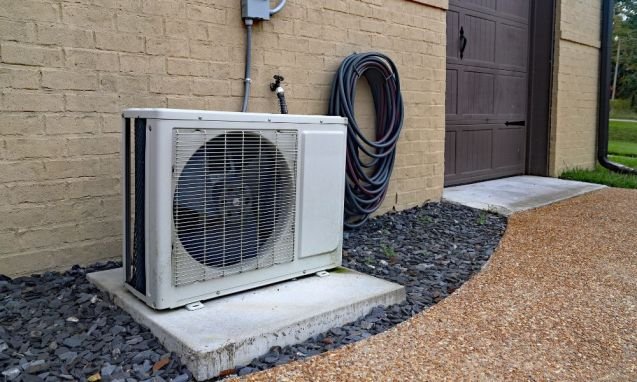
The outdoor condenser coil — the metal fins visible through the grille on the outdoor unit — rejects the heat absorbed from inside the house. When those fins are clogged with cottonwood fluff, grass clippings, dryer lint, or years of dirt, the heat cannot escape. The refrigerant stays hot, the compressor works harder, and the cooling output drops. A severely clogged condenser coil can reduce cooling capacity by 30% to 50%.
Clean the condenser coil at least once per cooling season. Turn off power at the disconnect box near the outdoor unit. Remove the screws securing the outer cover or the top panel. Most mini split outdoor units have a cover that lifts off after removing a few screws. Spray the coil from the inside outward with a garden hose — never a pressure washer, which folds the aluminum fins flat. Let the unit dry completely before restoring power. Straighten any bent fins with a fin comb ($8 to $15). Clear all vegetation and debris within 2 feet of the unit on all sides.
4. Low Refrigerant: The Mini Split Flare Fitting Problem
Mini splits are more prone to refrigerant leaks than central AC systems because of the flare fittings that connect the refrigerant lines to the indoor and outdoor units. A flare fitting is a copper tube end that has been expanded into a cone shape and compressed against a matching fitting by a flare nut. If the flare was not formed perfectly — off-center, cracked, or under-torqued — it leaks. A flare fitting leak is slow: it takes months or years for enough refrigerant to escape to affect cooling. The system worked fine when it was installed. Two or three summers later, it does not cool.
Signs of low refrigerant: the air from the indoor unit is cool but not cold, the larger insulated pipe at the outdoor unit is not cold and sweaty, ice forms on the indoor coil or the suction line at the outdoor unit, and a hissing sound comes from the indoor or outdoor unit. The system is a sealed circuit. Refrigerant does not get used up. If the charge is low, there is a leak. An EPA-certified technician must locate the leak, repair it, evacuate the system, and recharge to the precise weight specified on the nameplate. Leak repair and recharge costs $500 to $1,500.
Flare fitting leak — the most common mini split failure: A mini split refrigerant leak is at a flare fitting roughly 80% of the time. The remaining 20% is a factory defect in the coil. A technician recovering the refrigerant can often identify a flare leak by the presence of compressor oil around the flare nut. The repair involves cutting off the old flare, re-flaring the copper tube with a proper flaring tool (an eccentric flaring tool, not a cheap compression flaring tool), and re-tightening the flare nut to the manufacturer’s torque specification with a torque wrench. The difference between a flare that leaks and a flare that does not is the quality of the tool and the installer’s attention to the torque specification.
5. Inverter Board or Compressor Failure
A mini split’s compressor is driven by an inverter board — a power electronics module that converts incoming AC power to the variable-frequency DC power that controls the compressor’s speed. The inverter board is the most expensive electronic component in the system and the most common electrical failure point. When the inverter board fails, the compressor does not run, and the indoor unit blows room-temperature air. The outdoor unit may be silent, or the fan may run without the compressor.
An inverter board failure typically produces an error code on the indoor unit’s display — a blinking LED pattern or an alphanumeric code. Common error codes for inverter faults include communication errors (the indoor and outdoor units cannot talk to each other), overcurrent faults (the compressor is drawing too much current), and voltage faults (the incoming power is outside the acceptable range). Inverter board replacement costs $600 to $1,200. Compressor replacement costs $1,200 to $2,500. If both the inverter board and the compressor have failed on a unit more than 8 to 10 years old, replacing the entire outdoor unit — or the entire system — is often the better financial decision.
6. Communication Error Between Indoor and Outdoor Units
Mini splits use a communication cable — typically a 14-gauge or 16-gauge stranded wire — that carries data between the indoor and outdoor unit control boards. If that communication is interrupted — by a loose connection, a wire that was damaged during installation, or electromagnetic interference from nearby power lines — the indoor unit will display an error code and the compressor will not run. The indoor fan may run, but the air is not cold because the outdoor unit never received the command to start cooling.
Communication errors are almost always installation-related. The communication cable was not connected securely at the terminal block. The cable was damaged when it was pulled through the wall. The cable was run too close to high-voltage power lines, and the electromagnetic field is interfering with the data signal. A technician can diagnose a communication error by checking the wiring connections at both units and, if necessary, replacing the communication cable. The repair costs $200 to $500 for wiring diagnosis and repair. The parts are cheap — the cable itself is $1 to $2 per foot. The labor to access the connections and run a new cable if needed is the cost.
7. Electrical Issues: Breaker, Disconnect, or Power Supply
A mini split has a dedicated electrical circuit — typically 208/230 volts for the outdoor unit, with the indoor unit powered through the interconnection cable from the outdoor unit. If the circuit breaker for the outdoor unit has tripped, the entire system is dead: the outdoor unit is silent, the indoor unit may or may not have power (depending on whether it draws power from the outdoor unit or has its own circuit), and the remote control does nothing. Reset the breaker by flipping it fully to OFF, then back to ON. If the breaker trips again immediately, there is a short circuit in the outdoor unit — typically the inverter board or the compressor. Call a technician.
If the outdoor unit has power (the fan can run, or you hear a hum) but the indoor unit is dead, the indoor unit may not be receiving power through the interconnection cable. A loose wire connection at the outdoor unit’s terminal block can interrupt power to the indoor unit. This is a 10-minute fix for a technician: turn off power, open the outdoor unit’s electrical compartment, tighten the terminal screws for the indoor unit power wires, and restore power.
FAQ: Common Questions About Mini Split Not Cooling
One indoor unit is cooling but another is not. What does that mean?
In a multi-zone mini split system, each indoor unit has its own refrigerant circuit controlled by a solenoid valve in the outdoor unit. If one unit cools and another does not, the problem is specific to that indoor unit or its branch of the refrigerant circuit. Clean the filter on the non-cooling unit first. If the filter is clean, the solenoid valve for that zone may have failed (a $300 to $600 repair), the refrigerant charge may be too low (affecting the farthest unit first), or the indoor unit’s control board or fan motor may have failed.
My mini split cools fine but does not heat. Is that the same problem?
No. A mini split that cools but does not heat has a problem with the reversing valve — the component that switches the refrigerant flow direction between cooling and heating modes. The reversing valve is a solenoid-operated valve in the outdoor unit. When it fails, it sticks in cooling mode. The compressor runs, the refrigerant circulates, but the system cannot reverse the cycle to extract heat from the outdoor air. Reversing valve replacement costs $600 to $1,200 and requires recovering the refrigerant. This is a completely different repair from a cooling failure.
Clean the Filters, Check the Settings, Then Call for the Refrigerant Check
A mini split that is not cooling has lost airflow, refrigerant, or compressor function. Clean the filters first — this fixes more mini split cooling problems than any other single action. Verify the remote is set to COOL, the temperature is set low enough, and the timer is not shutting the system off. Clean the outdoor condenser coil. If those three zero-cost steps do not restore cooling, the problem is refrigerant, the inverter board, the compressor, or the communication wiring — all of which require a technician.
Mini splits are reliable machines with a typical service life of 12 to 20 years. The most common failures — dirty filters, dirty coils, and slow refrigerant leaks at flare fittings — are preventable with annual maintenance. A $150 to $250 annual mini split tune-up that cleans the filters, cleans the coils, checks the refrigerant pressures, and inspects the flare fittings pays for itself by preventing a $500 to $1,500 leak repair or a $1,200 inverter board replacement.